
Destination Wedding · Wedding Planning · Gujarat
Destination Wedding Music Checklist for Gujarat

Destination weddings — whether at a resort a few hours from home or further afield — add a layer of logistics that local weddings simply don't have. The music and entertainment side is often where couples underestimate the planning needed, since it depends on travel, venue coordination, and equipment transport in ways a hometown wedding doesn't.
Planning for travel disruption
Flight delays and cancellations happen, and a destination wedding leaves less room to absorb them than a local booking does. Ask your performer directly what their contingency plan looks like if travel is disrupted close to the date — whether they build in a buffer day before the first function, and whether they have a backup musician on call for any role that can't be delayed. A performer with genuine destination wedding experience will usually already have a clear answer to this rather than needing to think it through on the spot.
Confirm travel and logistics early
- Ask whether your performer's package includes travel, accommodation, and equipment transport, or whether these are billed separately.
- Confirm load-in and sound-check timing with the venue — destination venues often have tighter turnaround windows between functions than dedicated wedding venues.
- Check the venue's power supply and backup arrangements; a full live orchestra draws considerably more power than a DJ booth, and outdoor destination venues don't always have this sorted by default.
Plan for multiple functions across fewer days
Destination weddings often compress functions that would normally be spread across weeks into three or four consecutive days. This means your entertainment team needs to be capable of range — a devotional Bhakti Sandhya one evening, high-energy Sangeet the next, and a full reception orchestra after that — without the recovery time a longer local wedding calendar allows.
Weather and venue contingencies
Outdoor destination venues are beautiful but unpredictable. Ask your performer and venue coordinator about a covered backup option for the stage and equipment, and confirm this is agreed in writing rather than assumed. Live instruments, in particular, are sensitive to humidity and direct sun exposure over long outdoor sets.
Local band vs one that travels with you
For destination weddings within Gujarat or nearby states, couples sometimes consider hiring a local performer near the venue instead of bringing their own band along. The trade-off is real: a local band knows the venue's acoustics and logistics, but a band that's already worked with your family — and already understands your musical taste across every function — can deliver a far more personalised set without a first-time briefing call trying to cover everything a long-term relationship would already know. For weddings with three or more functions across the trip, most families find that consistency is worth more than local familiarity, and a good travelling band will coordinate directly with the venue in advance to close that gap anyway.
Equipment: what travels well, and what doesn't
Keyboards, sound systems, and most percussion travel reasonably well with standard flight-case protection. Instruments like sitar and harmonium are more sensitive — temperature swings and rough handling during transit can affect tuning and structural integrity, so ask your performer how they handle instrument transport, especially for flights rather than road travel. It's also worth confirming who is responsible for excess baggage charges for instrument cases, since this is a cost couples sometimes overlook until the invoice arrives.
Coordinating with your destination wedding planner
If you've hired a destination wedding planner, loop your music and entertainment vendor into the same coordination calls as your decor and catering teams, rather than managing them separately. Stage placement, power distribution, and load-in timing all interact with decor setup and catering service timing, and misalignment here is one of the most common last-minute stress points at destination weddings. A planner who's used to coordinating live performers will usually raise this themselves; if yours hasn't worked with a live band before, be proactive about introducing the two parties early.
Budgeting for a destination wedding band
Expect a destination booking to cost more than the same band's local rate, largely because of travel, accommodation, and the extra days musicians are away from other work. Ask for a clear breakdown of what's included — travel class, number of nights of accommodation, meals — rather than a single bundled figure, so you can compare quotes accurately across different performers and understand exactly what you're paying for beyond the performance itself.
Managing guest travel and the entertainment schedule together
Destination weddings often move large groups of guests together — shared flights, group transfers, a single check-in window — which means function start times can be less flexible than at a local wedding where guests trickle in individually. If most of your guests are arriving on the same flight or transfer schedule, share that timing with your performer so the first function's music can be planned around a realistic arrival window rather than a start time that assumes everyone is already in place.
A day-by-day example for a three-function destination wedding
- Day 1, evening: arrival and sound check at the venue, followed by a Sangeet Sandhya or welcome dinner set.
- Day 2, evening: Haldi or Mehndi in the late afternoon with a folk-forward set, transitioning into a devotional Bhakti Sandhya if your family has requested one.
- Day 3: wedding ceremony live accompaniment in the morning, followed by a full reception orchestra set in the evening, with a DJ handover for late-night dancing if planned.
A simple pre-booking checklist
- Confirm the full list of functions you need covered, and which instruments/format suit each.
- Get travel, accommodation, and equipment logistics in writing.
- Schedule sound checks for each function separately — venues and acoustics can vary significantly across a resort property.
- Share your guest list's musical taste profile (regional, generational, language mix) well in advance so the setlist can be prepared, not improvised.
Crystal Beats travels for destination weddings across India, bringing a full live band and production setup to resorts and venues outside Gujarat. If you're planning a destination wedding, use the booking form on this site to start the conversation early — logistics planning benefits from lead time.
Frequently Asked Questions
What should I confirm before booking music for a destination wedding?
Whether travel, accommodation, and equipment transport are included in the package, load-in and sound-check timing with the venue, and the venue's power supply and backup arrangements.
How does destination wedding entertainment differ from a local wedding?
Multiple functions are often compressed into three or four consecutive days, so the entertainment team needs to cover a wide range — devotional, high-energy, and formal reception — without much recovery time between events.
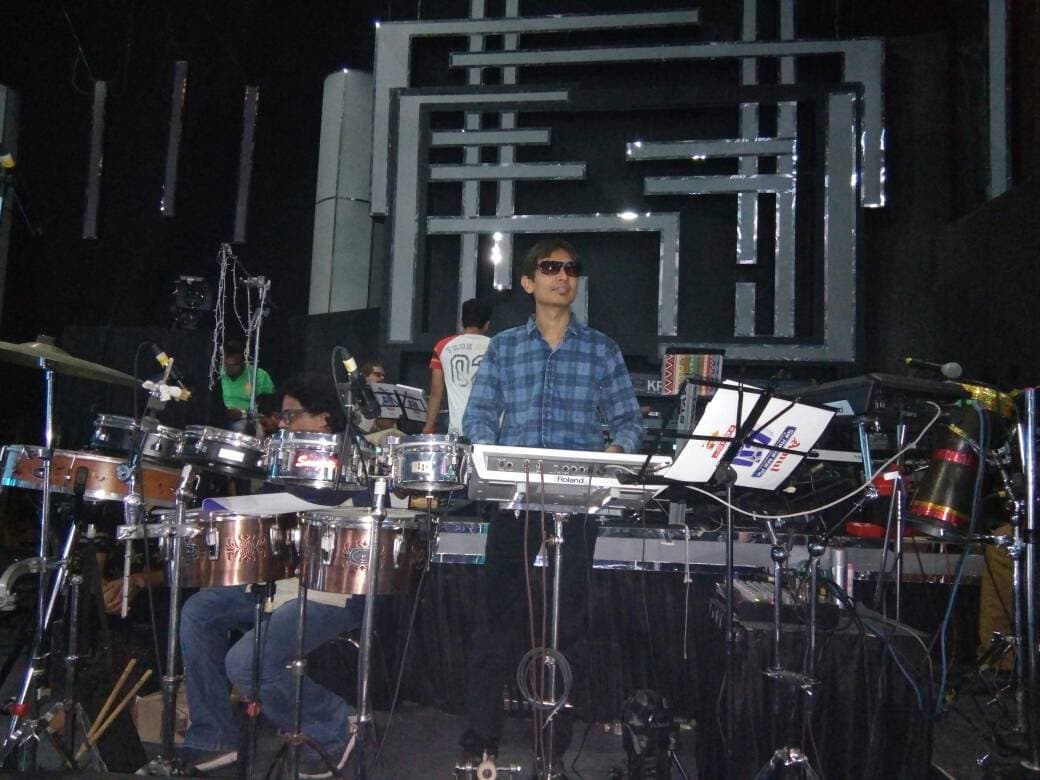
Written by Mrugesh Shukla, Tabla Visharad (distinction) and founder of Crystal Beats — 18+ years leading live performances and teaching at Crystal Beats Music Academy since 2007.
The guidance in this guide reflects real experience performing and teaching across Gujarat since 2007 — not generic advice.
In partnership with Rivavya Create and Trade LLP.
More from the blog

Garba Night Abroad: Bringing Authentic Gujarati Garba to Your NRI Sangeet
Garba at an NRI sangeet abroad can fall flat without a live dhol and a band that knows how to read an out-of-practice crowd. Here's how to get it right.
Booking an Indian Wedding Band From India for Your NRI Wedding Abroad
Flying a live band in from India for a UK, US, or Canada wedding takes different planning than a local booking. Here's the practical guide — lead times, logistics, and what to ask.
Questions to Ask a Band Master Before You Book
A quick checklist of questions to ask before confirming your wedding or event's band master — covering experience, instrument range, and logistics.